 |
| Andrzej Stasiukin ja Matkalla Babadagiin-kirjan fanitapaamisessa oli tilaa, sillä samanaikaisesti messuilla esiintyivät Jörn Donner ja presidentti. Suomentaja Päivi Paloposki kertoomielenkiintoisia anekdootteja Stasiukista ja hänen kirjoistaan.
Tänään oli ohjelmisto-kapteenin Kari Kettulan viimeinen päivä messujen ruorissa.
Jurtta: Salon ammattiopistossa (entinen Hakto) oppilaiden kanssa tehty vuonna 1995, sähkön koskematta, tulella, höryllä, käsillä, kirveellä, puukolla ja hevosella. Männystä' ja pihlajasta. Suomen lampaan villasta. Ohjaajina Hal Wynne-Jones ja allekirjoittanut.
|
Näytetään tekstit, joissa on tunniste yurt. Näytä kaikki tekstit
Näytetään tekstit, joissa on tunniste yurt. Näytä kaikki tekstit
7. lokakuuta 2012
Matkalla Babadagiin, Runon ja tarinan jurtassa


Runon, tarinoiden ja hiljaisuuden jurtta Turun kir...
tekotuulahdus: Runon, tarinoiden ja hiljaisuuden jurtta Turun kir...: Hiljaisuuden jurtta täynnä tarinaa, matkoja, runoutta ja rakkautta. 5-7.10.2012 Turku Ohjelma jurtassa TÄNÄÄN:


Jurtta (A-halli) Sunnuntai 7.10.
11.00 Hiljaisuuden jurtta
12.00
Volgan mutkasta Siperiaan (SKS). M.A.Castrenin seura esittää suomalais-ugrilaisia kansoja esitteleviä elokuvia
12.30
Eroottisen runouden kavalkadi. Runoilija J.K.Ihalainen virolaisine ja suomalaisine ystävineen
13.00
Kirjailija Seija Vilén: Pohjan akka (Avain). Haastattelija Katja Jalkanen
13.30
Miksi Nietzsche? Kolmas tila esittää
14.00
Andrzej Stasiukin ja Matkalla Babadagiin-kirjan fanitapaaminen. Suomentaja Päivi Paloposki kertoo aluksi Stasiukista ja hänen kirjoistaan
15.00
Kirjailija Lasse Berg (Ruotsi): Kalaharin aamunkoitto. Miten ihmisestä tuli ihminen? (Into Kustannus).
16.00 - 17.00 Hiljaisuuden jurtta
28. syyskuuta 2012
Runon, tarinoiden ja hiljaisuuden jurtta Turun kirjamessuilla 5-7.10
 |
| Hiljaisuuden jurtta täynnä tarinaa, matkoja, runoutta ja rakkautta. 5-7.10.2012 Turku |
Jurtta (A-halli) Perjantai 5.10.
11.00 Hiljaisuuden jurtta
12.00
Runojurtta. Runoviikko ry esittää, Varsinais-Suomen runokimara: runoilijat Tommi Parkko, Satu Haapala, Kimmo Leijala, Susinukke, Juha Kulmala, Tuula Sandström, Asko Lehtonen, Helianne Kallio, Sami Liuhto, Tapani Kinnunen, Veera Kivijärvi, Kalle Talonen, Mika Kivelä ja Esa Hirvonen
13.30
Runoilija Tommi Parkko: Runouden ilmiöitä (Avain). Haastattelija Tiina Aalto
14.00
Kirjailija Sini Kiuas: Kirjoittajakalenteri (Avain). Haastattelija Katja Jalkanen
14.30
Sanasadon syksy! Kustantaja Erkki Kiviniemi (Sanasato) kertoo legendaarisen Colin Wilsonin kirjasta: Sivullinen ihminen, josta on ilmestynyt pokkaripainos. Paikalla myös kirjailija Rauha Kejonen: Huuto, sekä runoilijat Heikki Jalava: Maailma on jälleen vieraampi, Juha Rautio: Häkki ja Joona Ruusuvuori: Ambulansseja taivaalla
15.00
Taiteilija Tiiti Mendelin ja taiteilija Tuula Nikulainen keskustelevat Siperian matkoista Tiitin käsintehtyjen matkakirjojen pohjalta.
15.30
Volgan mutkasta Siperiaan. M.A.Castrenin seura esittää suomalais-ugrilaisia kansoja esitteleviä elokuvia
16.00
Runojurtta: Runoviikko ry esittää Nauravat runoilijat/The Laughing Poets: Harri Hertell, DXXXA D, Risto Koo, Esa Hirvonen, Dirk Huelstrunk, Kate Fox ja Riina Särkilahti
Jurtta (A-halli) Lauantai 6.10.
11.00
Kirjailija Seppo Järvinen kertoo matkakirjastaan Rukki, mantra ja piilaakso (Enostone)
11.30
Kirjailija Gerdur Kristny (Islanti) keskustelee kirjastaan Verikaviot (Savukeidas) kirjailija Tapio Koivukarin kanssa ja lukee runojaan
12.00
WSOY:n ja Tammen runotunnit: runoilijat Anne Hänninen: Hiekkaleijat, Lauri Otonkoski: Origami, Aki Luostarinen: Ajan olo ja Marianna Kurtto: View-master, Aki Salmela: Vanitas, Merja Virolainen: Valloittaja. Haastattelijat Anna-Riikka Carlson ja Esa Silander
14.00
Volgan mutkasta Siperiaan (SKS). Dosentti Ildiko Lehtinen, toimittaja Kirsi Moring sekä professori Sirkka Saarinen kertovat kirjastaan. Haastattelija toimittaja Jukka Mallinen
14.30
Eesti Päivälehden toimittaja ja kirjailija Rein Sikk (Viro) ja toimittaja Harri Rinne keskustelevat Sikkin kirjasta Minu Ugrimurti
15.00
Volgan mutkasta Siperiaan. M.A.Castrenin seura esittää suomalais-ugrilaisia kansoja esitteleviä elokuvia
15.30
Kirjailija Matti Rämö: Polkupyörällä Jäämerelle (Minerva). Haastattelija ex-kansanedustaja Janina Andersson.
16.00
Corto Maltese Siperiassa (Jalava). FK Heikki Kaukoranta kertoo. Corto Maltese-fanitapaaminen
16.45
Elämän korjaajat. Kädentaitojen ylistys. Suomentaja Tuukka Tomperi ja moottoripyöräilyn asiantuntija Esa Almgren esittelevät Matthew B. Crawfordin kirjoittamaa elämäntaidon ja uuden elämäntavan bestselleriä. (niin & näin -kirjat)
17.15
Eroottisen runouden kavalkadi. Runoilija J.K.Ihalainen virolaisine ja suomalaisine ystävineen
18. heinäkuuta 2012
The Yurt is my Crater. The Rigging.
The Yurt is my crater. It Felt like burning. Woolen decay.
Burning Burning. Rigging. Theater Quo Vadis workout at Saaren kartano -residency.
Poetic Science and the Scene of Combustion. Next stop Madrid.
Burning Burning. Rigging. Theater Quo Vadis workout at Saaren kartano -residency.
Poetic Science and the Scene of Combustion. Next stop Madrid.
 | ||
BurningBurning . The rigging.
|

8. heinäkuuta 2011
DIY Friends Whale Festival Lofoten Henningsvaer
Welcome to Celebrate the Beauty of the Blue Planet and Whales with us!
Heike Vesters, David Rothenberg, Rauno Lauhakangas, Lasse-Marc Riek and Tuula Nikulainen.

Registration and more info: heike_vester((att))ocean-sounds.com
http://www.ocean-sounds.com/eng/
Info also tuulanikulainen((att))gmail.com
Article about Heike and Ocean-sounds in Finnish VOIMA-magazine:
Lue Voima-lehden artikkeli Heiken valastutkimuksesta "Lofoottien kaunottaret"
PROGRAM:
Lofoten Whale Festival – Henningsvaer 01.-06.08.2011
A meeting of humans and whales: science, music, art and tourism
A one week gathering celebrating the culture and nature of our cetacean species in the Lofoten waters: pilot whales, killer whales, different dolphins, harbor porpoises, minke whales, fin whales and humpback whales. There will be talks, special tours with scientists, naturalists, artists and musicians to introduce the wide human ways of relating to these mysterious and fascinating animals. A group of internationally-known researchers from many different fields will converge upon Henningsvær in early August to present the facts and mysteries we have discovered about these important ocean creatures. National and International renowned artists will present their work and interact with the whales, people and nature of Lofoten.
The goal will be to raise awareness, educate people about the marine ecosystem and its wonderful creatures, embedded in artistic and fun activities!
Actions:
*Sailing trips to find the whales and play music for them, film interactions, do research
*Talks, films, presentations about whales and the marine ecosystem at the Ocean Sounds Center
*Concerts: downstairs at the Ocean Sounds center (or at local coffee shop)
*Discussion rounds & party
...open for your own action...
Objective:
To celebrate the importance of the cetaceans in arctic Norwegian waters, to educate children and people and to enhance the experience of visitors to Henningsvær and to boost the local tourist economy.
Accommodation: bring your own tent or spend some nights at the hotels, Rorbuer, or hostels in Henningsvaer.
Food: we will arrange for a low budget soup kitchen on the island, otherwise use the variety of restaurants and cafes in Henningsvaer.
Costs & funds: this is a low budget event, so travel, accommodation and food has to be covered by the participants, unless we will get extra funds. If you have an idea where and how to get funding, please do not hesitate to get into action!
There will be cover charges for music events and boat excursions, the rest of the activities should be free.
Donations are very welcome!!
Whale-festival in Henningsvaer
The fascination of animals that are mysterious to us has always attracted our minds. Whales are creatures that because of their, for us remote aquatic life, have always been “food” for stories of monsters and secret lands. Throughout history people have been scared, or delighted by the sight of such sea “monsters”, there are both stories of hunting to extinctions out of pure greed and stories about cooperative and even life saving moments with dolphins and whales. During the last century people managed to almost erase all whales and dolphins form our planet, but in the last minute it was stopped due to a greater respect for those creatures of the sea. Instead non lethal whale watching developed all over the world with great success. People started to love and admire those animals. Likewise in science whales and dolphins have become a fast field of studies from genetics to behavior or medicine, we started to learn a lot about those mysterious animals.
However, we still have to learn a lot and not even half of their biology is known to us.
In Henningsvaer on the Lofoten islands, 68 degrees north, is where both whales and fishermen live. Here is where we want to celebrate life in the sea in coexistence with people.
Why?
Because it is unique, fascinating and beautiful!
All year round different species of whales visit the water around the Lofoten islands. During the summer months you find most species in the Vestfjord, from the local small harbor porpoises, to different dolphins (Atlantic white sided and beaked dolphins), smaller baleen whales such as minke whales (9m) to larger ones like the humpback whale (14m) and the second largest whale in the world, the fin whale (24m). However, some highly social whales come in family groups as well, the matrilineal killer whales and long-finned pilot whales. Especially pilot whales are regular visitors and may stay for a week. Often they are curious about the boat and come very close, sometimes they allow us to stay for a longer time, or they just inspect us, may whistle to us and then leave again. You never know with these whales!
Musician and Philosopher David Rothenberg has interacted with music and different kind of whales all over the world. He will come to Henningsvaer and will try to play his clarinet to the pilot whales (and other whales) to document their reaction in form of vocal interactions, behavior in air and movement. We will document this interaction with audio recordings and filming as well as pictures and GPS locations.
People participating and visiting the festival can witness this and get an introduction to our research either out at sea or in form of lectures, slide shows, films and discussions at the center. Our goal is to create a bridge between the fascinating world of the whales and people. We want to show the beauty of the whales’ lives, their appearance, behavior, sounds and communication with their environment. At the same time, we want to give art and science a platform to interact and underline the importance of life in the sea for us. To round it up, we want to give everybody the possibility to express themselves and discuss their opinion.
Background: The idea for this whale festival developed under a meeting and participation at the 3 week art and ecology exhibition “Gentle Action” in Oslo at Kunstnerens Hus, 25.10-14.11.2010.
Main Participants/base organisation:
Heike Vester
Biologist & Founder of Ocean Sounds (www.ocean-sounds.com)
Ocean Sounds is a private organization that is dedicated to the research of marine animals, public education, and conservation of the marine environment. The idea of Ocean Sounds began to be realized in August 2005 with the purpose of combining research with education and tourism. It is based in the Arctic, in Henningsvær, a small old fishing and whaling community in northern Norway, which is right in the heart of the Lofoten Islands.
Heike Vester, a biologist (Masters of Biology in Arctic Biology from the University of Tromsoe, Norway) is specialized in bio-acoustics, animal behavior & communication and animal physiology. She lives in Henningsvaer since 2004 and founded Ocean Sounds in 2005. Currently she works on a PhD in cooperation with the Cognitive Ethology Group at the German Primate Center, University of Goettingen, Germany and the Max Planck Institute for Dynamics and Self-Organization, in Goettingen, Germany.
Her intention is to organize and participate in the whale festival in order to educate the world about the whales of Lofoten, educate them about the biology and communication, and bring people from different disciplines together. By opening up the science world and combine it with art, the message may reach a lot of different people, especially children. She wants to demonstrate what beautiful nature, especially the life in the sea, the local people of Lofoten have. And, thereby creating an awareness that will foster future protection and pride for their natural environment and animals at sea and the peoples’ way of living.
The plan is to organize:
a) talks, discussion rounds and films in the science center of Ocean Sounds
b) boat excursions to find the whales and supervise/record/study the interaction between David Rothenbergs’ music and the whales’ reaction.
This event will also be a starting point for a documentary film of long finned pilot whales and humans.
David Rothenberg
musician, philosopher, writer, naturalist
www.davidrothenberg.net
David Rothenberg first came to Norway in the 1980s to work with philosopher Arne Naess. He later translated Naess’s Ecology, Community and Lifestyle into English and wrote a conversational biography of Naess, Is It Painful to Think?, which was a best-seller in Norway in 1992.
Combining his training with Naess and his work as a musician, Rothenberg has written several book on music in nature, including Why Birds Sing, which has been published in seven languages, and Thousand Mile Song, about the music of whales and his experience playing his clarinet along with them. This latter book is currently being turned into three documentary films.
Rothenberg is Professor of Philosophy and Music at the New Jersey Institute of Technology, and his latest recording One Dark Night I Left My Silent House was released on the ECM label, home of Jan Garbarek, Tord Gustavsen, and many other Norwegian musicians, in 2010.
In the summer of 2011 Rothenberg hopes to bring his music and his ideas about the sound world of whales to Henningsvær in Lofoten for a series of boat trips, first to interact live with pilot whales and their sounds (something never before documented in Norway), and then with visitors to the festival to listen to and to show how whale sounds are scientifically analyzed, and then with one or two concerts, performed solo or with local musicians, combining the sounds of the sea with Rothenberg’s style of jazz improvisation, very influenced by the years he spent in Norway and the fine musicians of this country.
The aim of these series of events will be to increase general appreciation for the beauty and presence of whales as part of the ecology of the Lofoten Islands and Northern Norway as a whole.
Rauno Lauhakangas
Physicist , whale activist
The whale activism of Rauno Lauhakangas started in Norway, Lofoten in 1990. The basic idea was presented by his 8-year old son: “The best whale conservation is whale watching”. Since those days Lauhakangas has founded several whale watching companies in Europe, co-operating in Caribbean, and even in Japan.
While working at CERN (European Organization for Nuclear Research) he was in close collaboration with the WWW research unit, and he decided to build and submit to the WWW Virtual Library a website about whale watching carrying the name www.whaleweb.org.
For the last 10 years he has studied in particular the migration of white whales in the White Sea and Northern Norway. This work has been done together with Russian scientists.
In the summer of 2011 Lauhakangas will tell stories about human and whale encounters in Fennoscandia and North-West Russia after the glacial period. He will also perform with a demonstrational device how whales communicate by using holozonic underwater images. The device is based on sounds and a laser beam.
Tuula Nikulainen
is a visual artist and environmental activist working in the field of art and ecology. Tuula’s background is in folkloristics, northern shamanism and nomads. She has studied nomad technologies, such as yurt making, and stayed with nomads in Mongolia teaching their forgotten arts and crafts, felt-boot-making. Tuula is also the founder of the community art and ecology projects Sunny Future and Halikonlahti Green Art in southern Finland. Tuula has been enchanted by whales ever since her oldest daughter Saana started her “studies” in marine mammals at a very early age about twenty years ago...
Tuula will bring a yurt to the whalefestival, and whale stories originally learnt from the Maori people of New Zealand.
More about
http://www.halikonlahti.net
http://tekotuulahdus.blogspot.com/
http://vedentaika.blogspot.com/
Lasse-Marc Riek
www.lasse-marc-riek.de
www.gruenrekorder.de
uses different forms of expression in his producing. His works are interdisciplinary and can be conceived as groups of works of both visual art (action and conceptual art) and sound art. His art of sound can be described in terms such as acoustic ecology, bio acoustics and soundscapes. Here, Riek uses acoustic field recordings, storing them with different recording media, editing, archiving and presenting them in different contexts.
Since 1997, he has operated internationally with exhibitions, releases, concerts, lectures, workshops, awards, projects and given guest performances in galleries, art museums, churches and
universities. Contributions in public media as well as in podcasts. Scholarships and artist-in-residence programs realised in Europe and Africa.
Since 2003 founder member of the audio publishing company Gruenrekorder, focusing on soundscapes, field recordings and electro-acoustic compositions, and in this connection, acting
internationally with artists and scientists.
Lasse-Marc Riek will perform a Soundscape out of orca and pilot whale signals recorded by Heike Vester.
He runs the label Gruenrekorder and released among more than 80 releases the first CD of ocean-sounds.
During the whole festival Riek will record the activities to prepare future projects like a audio work on CD and radio work, too.
A CD will be published via Gruenrekorder later this year!
Co-operation partner Gruenrekorder, Germany
Gruenrekorder understands itself as an organisation with the aim of promoting experimental music and phonography. Phonography considers nature / the environment as an acoustic experience, loaded with musical sounds. It is as a form of art and culture, that Gruenrekorder promotes phonography. We therefore organise events, lectures, publications and exhibitions as well as artistic projects in the fields of phonography and experimental music.
Info also tuulanikulainen((att))gmail.com
Article about Heike and Ocean-sounds in Finnish VOIMA-magazine:
Lue Voima-lehden artikkeli Heiken valastutkimuksesta "Lofoottien kaunottaret"
PROGRAM:
Lofoten Whale Festival – Henningsvaer 01.-06.08.2011
A meeting of humans and whales: science, music, art and tourism
A one week gathering celebrating the culture and nature of our cetacean species in the Lofoten waters: pilot whales, killer whales, different dolphins, harbor porpoises, minke whales, fin whales and humpback whales. There will be talks, special tours with scientists, naturalists, artists and musicians to introduce the wide human ways of relating to these mysterious and fascinating animals. A group of internationally-known researchers from many different fields will converge upon Henningsvær in early August to present the facts and mysteries we have discovered about these important ocean creatures. National and International renowned artists will present their work and interact with the whales, people and nature of Lofoten.
The goal will be to raise awareness, educate people about the marine ecosystem and its wonderful creatures, embedded in artistic and fun activities!
Actions:
*Sailing trips to find the whales and play music for them, film interactions, do research
*Talks, films, presentations about whales and the marine ecosystem at the Ocean Sounds Center
*Concerts: downstairs at the Ocean Sounds center (or at local coffee shop)
*Discussion rounds & party
...open for your own action...
Objective:
To celebrate the importance of the cetaceans in arctic Norwegian waters, to educate children and people and to enhance the experience of visitors to Henningsvær and to boost the local tourist economy.
Accommodation: bring your own tent or spend some nights at the hotels, Rorbuer, or hostels in Henningsvaer.
Food: we will arrange for a low budget soup kitchen on the island, otherwise use the variety of restaurants and cafes in Henningsvaer.
Costs & funds: this is a low budget event, so travel, accommodation and food has to be covered by the participants, unless we will get extra funds. If you have an idea where and how to get funding, please do not hesitate to get into action!
There will be cover charges for music events and boat excursions, the rest of the activities should be free.
Donations are very welcome!!
Whale-festival in Henningsvaer
The fascination of animals that are mysterious to us has always attracted our minds. Whales are creatures that because of their, for us remote aquatic life, have always been “food” for stories of monsters and secret lands. Throughout history people have been scared, or delighted by the sight of such sea “monsters”, there are both stories of hunting to extinctions out of pure greed and stories about cooperative and even life saving moments with dolphins and whales. During the last century people managed to almost erase all whales and dolphins form our planet, but in the last minute it was stopped due to a greater respect for those creatures of the sea. Instead non lethal whale watching developed all over the world with great success. People started to love and admire those animals. Likewise in science whales and dolphins have become a fast field of studies from genetics to behavior or medicine, we started to learn a lot about those mysterious animals.
However, we still have to learn a lot and not even half of their biology is known to us.
In Henningsvaer on the Lofoten islands, 68 degrees north, is where both whales and fishermen live. Here is where we want to celebrate life in the sea in coexistence with people.
Why?
Because it is unique, fascinating and beautiful!
All year round different species of whales visit the water around the Lofoten islands. During the summer months you find most species in the Vestfjord, from the local small harbor porpoises, to different dolphins (Atlantic white sided and beaked dolphins), smaller baleen whales such as minke whales (9m) to larger ones like the humpback whale (14m) and the second largest whale in the world, the fin whale (24m). However, some highly social whales come in family groups as well, the matrilineal killer whales and long-finned pilot whales. Especially pilot whales are regular visitors and may stay for a week. Often they are curious about the boat and come very close, sometimes they allow us to stay for a longer time, or they just inspect us, may whistle to us and then leave again. You never know with these whales!
Musician and Philosopher David Rothenberg has interacted with music and different kind of whales all over the world. He will come to Henningsvaer and will try to play his clarinet to the pilot whales (and other whales) to document their reaction in form of vocal interactions, behavior in air and movement. We will document this interaction with audio recordings and filming as well as pictures and GPS locations.
People participating and visiting the festival can witness this and get an introduction to our research either out at sea or in form of lectures, slide shows, films and discussions at the center. Our goal is to create a bridge between the fascinating world of the whales and people. We want to show the beauty of the whales’ lives, their appearance, behavior, sounds and communication with their environment. At the same time, we want to give art and science a platform to interact and underline the importance of life in the sea for us. To round it up, we want to give everybody the possibility to express themselves and discuss their opinion.
Background: The idea for this whale festival developed under a meeting and participation at the 3 week art and ecology exhibition “Gentle Action” in Oslo at Kunstnerens Hus, 25.10-14.11.2010.
Main Participants/base organisation:
Heike Vester
Biologist & Founder of Ocean Sounds (www.ocean-sounds.com)
Ocean Sounds is a private organization that is dedicated to the research of marine animals, public education, and conservation of the marine environment. The idea of Ocean Sounds began to be realized in August 2005 with the purpose of combining research with education and tourism. It is based in the Arctic, in Henningsvær, a small old fishing and whaling community in northern Norway, which is right in the heart of the Lofoten Islands.
Heike Vester, a biologist (Masters of Biology in Arctic Biology from the University of Tromsoe, Norway) is specialized in bio-acoustics, animal behavior & communication and animal physiology. She lives in Henningsvaer since 2004 and founded Ocean Sounds in 2005. Currently she works on a PhD in cooperation with the Cognitive Ethology Group at the German Primate Center, University of Goettingen, Germany and the Max Planck Institute for Dynamics and Self-Organization, in Goettingen, Germany.
Her intention is to organize and participate in the whale festival in order to educate the world about the whales of Lofoten, educate them about the biology and communication, and bring people from different disciplines together. By opening up the science world and combine it with art, the message may reach a lot of different people, especially children. She wants to demonstrate what beautiful nature, especially the life in the sea, the local people of Lofoten have. And, thereby creating an awareness that will foster future protection and pride for their natural environment and animals at sea and the peoples’ way of living.
The plan is to organize:
a) talks, discussion rounds and films in the science center of Ocean Sounds
b) boat excursions to find the whales and supervise/record/study the interaction between David Rothenbergs’ music and the whales’ reaction.
This event will also be a starting point for a documentary film of long finned pilot whales and humans.
David Rothenberg
musician, philosopher, writer, naturalist
www.davidrothenberg.net
David Rothenberg first came to Norway in the 1980s to work with philosopher Arne Naess. He later translated Naess’s Ecology, Community and Lifestyle into English and wrote a conversational biography of Naess, Is It Painful to Think?, which was a best-seller in Norway in 1992.
Combining his training with Naess and his work as a musician, Rothenberg has written several book on music in nature, including Why Birds Sing, which has been published in seven languages, and Thousand Mile Song, about the music of whales and his experience playing his clarinet along with them. This latter book is currently being turned into three documentary films.
Rothenberg is Professor of Philosophy and Music at the New Jersey Institute of Technology, and his latest recording One Dark Night I Left My Silent House was released on the ECM label, home of Jan Garbarek, Tord Gustavsen, and many other Norwegian musicians, in 2010.
In the summer of 2011 Rothenberg hopes to bring his music and his ideas about the sound world of whales to Henningsvær in Lofoten for a series of boat trips, first to interact live with pilot whales and their sounds (something never before documented in Norway), and then with visitors to the festival to listen to and to show how whale sounds are scientifically analyzed, and then with one or two concerts, performed solo or with local musicians, combining the sounds of the sea with Rothenberg’s style of jazz improvisation, very influenced by the years he spent in Norway and the fine musicians of this country.
The aim of these series of events will be to increase general appreciation for the beauty and presence of whales as part of the ecology of the Lofoten Islands and Northern Norway as a whole.
Rauno Lauhakangas
Physicist , whale activist
The whale activism of Rauno Lauhakangas started in Norway, Lofoten in 1990. The basic idea was presented by his 8-year old son: “The best whale conservation is whale watching”. Since those days Lauhakangas has founded several whale watching companies in Europe, co-operating in Caribbean, and even in Japan.
While working at CERN (European Organization for Nuclear Research) he was in close collaboration with the WWW research unit, and he decided to build and submit to the WWW Virtual Library a website about whale watching carrying the name www.whaleweb.org.
For the last 10 years he has studied in particular the migration of white whales in the White Sea and Northern Norway. This work has been done together with Russian scientists.
In the summer of 2011 Lauhakangas will tell stories about human and whale encounters in Fennoscandia and North-West Russia after the glacial period. He will also perform with a demonstrational device how whales communicate by using holozonic underwater images. The device is based on sounds and a laser beam.
Tuula Nikulainen
is a visual artist and environmental activist working in the field of art and ecology. Tuula’s background is in folkloristics, northern shamanism and nomads. She has studied nomad technologies, such as yurt making, and stayed with nomads in Mongolia teaching their forgotten arts and crafts, felt-boot-making. Tuula is also the founder of the community art and ecology projects Sunny Future and Halikonlahti Green Art in southern Finland. Tuula has been enchanted by whales ever since her oldest daughter Saana started her “studies” in marine mammals at a very early age about twenty years ago...
Tuula will bring a yurt to the whalefestival, and whale stories originally learnt from the Maori people of New Zealand.
More about
http://www.halikonlahti.net
http://tekotuulahdus.blogspot.com/
http://vedentaika.blogspot.com/
Lasse-Marc Riek
www.lasse-marc-riek.de
www.gruenrekorder.de
uses different forms of expression in his producing. His works are interdisciplinary and can be conceived as groups of works of both visual art (action and conceptual art) and sound art. His art of sound can be described in terms such as acoustic ecology, bio acoustics and soundscapes. Here, Riek uses acoustic field recordings, storing them with different recording media, editing, archiving and presenting them in different contexts.
Since 1997, he has operated internationally with exhibitions, releases, concerts, lectures, workshops, awards, projects and given guest performances in galleries, art museums, churches and
universities. Contributions in public media as well as in podcasts. Scholarships and artist-in-residence programs realised in Europe and Africa.
Since 2003 founder member of the audio publishing company Gruenrekorder, focusing on soundscapes, field recordings and electro-acoustic compositions, and in this connection, acting
internationally with artists and scientists.
Lasse-Marc Riek will perform a Soundscape out of orca and pilot whale signals recorded by Heike Vester.
He runs the label Gruenrekorder and released among more than 80 releases the first CD of ocean-sounds.
During the whole festival Riek will record the activities to prepare future projects like a audio work on CD and radio work, too.
A CD will be published via Gruenrekorder later this year!
Co-operation partner Gruenrekorder, Germany
Gruenrekorder understands itself as an organisation with the aim of promoting experimental music and phonography. Phonography considers nature / the environment as an acoustic experience, loaded with musical sounds. It is as a form of art and culture, that Gruenrekorder promotes phonography. We therefore organise events, lectures, publications and exhibitions as well as artistic projects in the fields of phonography and experimental music.
23. toukokuuta 2011
Tuhkaa tuulessa, emo synnyttää
Islanti
 |
| Burning Burning Quo Vadis |
Tuhka
Tuhka on kasvi- ja eläinsolukkojen palamisjäännös. Kasvien tuhkassa on kaliumia, natriumia, kalsiumia, magnesiumia, rautaa, fosfaatteja, sulfaatteja ja karbonaatteja. Aikamoista lannoitusainetta. Nykyisin energiapuun tuhkaa ei kuitenkaan suositella lannoitteeksi kasvimaalle, koska se sisältää niin paljon sinne ei-kuuluvia ympäristömyrkkyjä, raskasmetalleja, mm. kadmiumia ja lyijyä. Emme pääse karkuun virheitämme.
Meret happamoituvat. Ennen kemiallisia valmistusmenetelmiä soodaa uutettiin meriheinien tuhkasta. Sooda on vanha saippuan raaka-aine. Soodaliuos on emäksistä, liukasta ja lipevää sekä puhdistavaa. Tuhkaa liottamalla syntyy lipeää, voimakkaan emäksistä ja syövyttävää lientä. Kuka lipeää?
Meret happamoituvat. Ennen kemiallisia valmistusmenetelmiä soodaa uutettiin meriheinien tuhkasta. Sooda on vanha saippuan raaka-aine. Soodaliuos on emäksistä, liukasta ja lipevää sekä puhdistavaa. Tuhkaa liottamalla syntyy lipeää, voimakkaan emäksistä ja syövyttävää lientä. Kuka lipeää?
Vuoroin saamme saippuaoopperaa ja toisena vuonna tuhkatkin viedään pesästä. Tuhkien viemisestä seuraa sadon väheneminen, ei ole millä lannoittaa. Elämämme on happo-emäs-tasapainottelua, niin arki ja terveytemme kuin ympäristömme vointi sekä puheenparsi riippuvat hapoista ja emäksistä.

Emäs
Emäs-sana viittaa emoon, emään, josta meillä on myös johdannainen emätin. Ei voi olla sattumaa, että kuukausittainen munasolun irtoaminen eli ovulaatio saa aikaan emäsryöpyn emättimeen. Hedelmöittymiseen tarvitaan emäksistä siemennestettä, joka suojaa ja kuljettaa siittiöitä kohti munajohtimia. Ovulaation aikana kohdunkaulassa sijaitsevat rakkulat erittävät myös emäksistä limaa siittiöiden suojaamiseksi. Varsinainen hedelmöittyminen sekä sikiön kehitys tapahtuvat emäksisessä ympäristössä. Emättimen liika happamuus voi puolestaan estää hedelmöittymisen. Emä kuuluu äidinkielemme vanhimpaan sanastoon.
Kielen vanhimman kerrostuman sanat kertovat ymmärryksestä, jossa kaikki teot, asiat, oliot ja aineet ovat yhteydessä toisiinsa. Ruokaa tarkoittava vanha sana on pala, joka esiintyy vieläkin aamupalana, huikopalana. Palaminen on energiaa, tuhka uutta emäsvoimaa. Nykyisen ruokavaliomme palat tuottavat liikahappoisuutta.
Huopa
Olen käsitellyt paljon villaa huovuttamalla. Huovuttaminen on emäksinen prosessi jossa hyödynnetään villan heikkoutta emäkselle. Emäksisellä saippualla liuotetaan kuidun keratiinipinta, jotta saadaan kuidun pintasuomut esille ja karhelle lämmön ja muokkauksen vauhdittaen prosessia. Huovutuksessa villan käpysuomut nousevat ja kiinnittyvät toisiinsa, takkuuntuvat. Mitä kauemmin huovutetaan, sitä tiukempaa huopaa syntyy. Huopa on kuin synnytys.
Kielen vanhimman kerrostuman sanat kertovat ymmärryksestä, jossa kaikki teot, asiat, oliot ja aineet ovat yhteydessä toisiinsa. Ruokaa tarkoittava vanha sana on pala, joka esiintyy vieläkin aamupalana, huikopalana. Palaminen on energiaa, tuhka uutta emäsvoimaa. Nykyisen ruokavaliomme palat tuottavat liikahappoisuutta.
Huopa
Olen käsitellyt paljon villaa huovuttamalla. Huovuttaminen on emäksinen prosessi jossa hyödynnetään villan heikkoutta emäkselle. Emäksisellä saippualla liuotetaan kuidun keratiinipinta, jotta saadaan kuidun pintasuomut esille ja karhelle lämmön ja muokkauksen vauhdittaen prosessia. Huovutuksessa villan käpysuomut nousevat ja kiinnittyvät toisiinsa, takkuuntuvat. Mitä kauemmin huovutetaan, sitä tiukempaa huopaa syntyy. Huopa on kuin synnytys.
 |
| Mongolia, Mankhan Sum 1992 |
Mongolia
Ymmärsin jotain perimmäistä vaeltaessani 90-luvun alussa Altai-vuorilla. Piikkipensasmaiseen aluskasvillisuuteen oli takertunut lampaan villoja. Mietin, miten ihmisten on täytynyt jo aikojen alussa kerätä villilampaiden karvoja talteen ja pehmittää niillä vuoteensa. Arvelen edelleen, että maailman ensimmäinneen huopa on syntynyt rakastelemalla! (ja olen saanut teorialle vahvistusta, siitä joskus myöhemmin)
Ymmärsin jotain perimmäistä vaeltaessani 90-luvun alussa Altai-vuorilla. Piikkipensasmaiseen aluskasvillisuuteen oli takertunut lampaan villoja. Mietin, miten ihmisten on täytynyt jo aikojen alussa kerätä villilampaiden karvoja talteen ja pehmittää niillä vuoteensa. Arvelen edelleen, että maailman ensimmäinneen huopa on syntynyt rakastelemalla! (ja olen saanut teorialle vahvistusta, siitä joskus myöhemmin)
Mongoliassa jurtan huopaisten seinien valmistukseen osallistuvat kaikki, lapsista mummuun ja vaariin. Vanhimmat naiset, emot, kantavat vastuun, sillä naisilla on mongolien mukaan luontaisia maagisia kykyjä, joilla varmistetaan hyvän huovan synty. Mongolien naista tarkoittavasta sananjuuresta eme johtuvat myös sanat vaimo, kätilö, lääke, parantaja, lääkäri, yrtti, lääke ja huume.
Hevosten tai kamelien vetämä huopa syntyykin kuin taiasta: ensin naiset asettelevat villat sikin sokin ristiin rastiin äitihuovan päälle, miehet käärivät villat sydänpuun kanssa tiukalle rullalle, sitovat sen ja käärivät äidin ja tyttären vielä vuotaan. Tyttöä juotetaan lämpimällä saippualiuoksella, naiset viimeistelevät hevosten perään seuraavaksi asetettavan raskaan paketin ripsottelemalla sen päälle hapanta tammanmaitoa. Sanovat näin pyhän valkean villan säilyvän valkeana. Minusta se on myös rituaalinen ele taspainolle sekä happaman ja emäksen hedelmälliselle liitolle. Jonkin ajan kuluttua ratsastamalla vetäen pyöritetty käärö avataan. Onnenhuokaus, sillä ihme on jälleen kerran tapahtunut, villakuidut ovat tiivistyneet vahvaksi kankaaksi, huovaksi, ilman sitovia lankoja, kudetta tai lointa.
Huopa on ihmisen vanhin jaloste eli tietoisesti raaka-ainetta jalostamalla synnytetty. Villan luontainen happamuus (ph) on sama kuin ihmisen iholla. Joseph Beuys on kutsunut huopaa ihmisen "toiseksi ihoksi". Huopa on huuhdeltava huolella, mahdollisuuksien mukaan tasapainotettava heikolla orgaanisperäisellä hapolla. Muinaiset soturit osasivat vahvistaa huopahaarniskoitaan kastelemalla ne aika ajoin viinietikkaan (Tacitus). Ihmisen emäksiset eritteet kuluttaisivat huovan loppuun -ja tuhka. Tuhka syö villaa, joten nykyään jurtan huovat onkin suojattu puuvillakankailla tai ruokomatoilla.
Huopa on ihmisen vanhin jaloste eli tietoisesti raaka-ainetta jalostamalla synnytetty. Villan luontainen happamuus (ph) on sama kuin ihmisen iholla. Joseph Beuys on kutsunut huopaa ihmisen "toiseksi ihoksi". Huopa on huuhdeltava huolella, mahdollisuuksien mukaan tasapainotettava heikolla orgaanisperäisellä hapolla. Muinaiset soturit osasivat vahvistaa huopahaarniskoitaan kastelemalla ne aika ajoin viinietikkaan (Tacitus). Ihmisen emäksiset eritteet kuluttaisivat huovan loppuun -ja tuhka. Tuhka syö villaa, joten nykyään jurtan huovat onkin suojattu puuvillakankailla tai ruokomatoilla.
 |
| Huopa ei pala, vaan muuttuu tulessa suoraan tuhkaksi. |
Vuonna 2004 tein näyttelyä Baskimaahan eli Euskal Herriaan. Etsin vessaa. Vertailin ovitekstejä ja löysin etsimäni tavaamalla ovesta eme-jotakin! Euskara-kielentutkiskelu tuotti mielenkiintoisen tuloksen: emätin on baskin kielellä ematutu. Sukulaisia olemme, emojen kautta! Eipä tuota olleet huomanneet baskimaahan avioituneet suomalaiset oppaammekaan...
Grimsvötn´n tuhka
Grimsvöt´n tuhka on vulkaanista tulivuoren tuhkaa, joka koostuu kivi- ja lasihiukkasista, maan kuoren sydämen palasista, eikä orgaanisista palamisjäänteistä.
Tulivuori puhuu: liikkukaa hiljaa, ajan kanssa, pysykää maanpinnalla ja huolehtikaa ympäristönne tasapainosta lisäämällä emästä, emoisuutta, suojaa.
Jos joku puhuu potaskaa hän suoltaa uutettua tuhkaa, syövyttävää emäksistä tarinaa. Kaikella on rajansa. Liika syövyttää, syöpyy syöpä.
 | ||
| Quo Vadis Burnin Burning produktion huopaisia sitaatteja - kokeiluja Saaren kartanossa 2010. Ensi-ilta 10.9.2011 Halikonlahti Green Art
|

22. helmikuuta 2011
The Yurt Next Stop - Jurttapysäkki
Next Stop
Lofoten 1-7.8.2011
Storytelling Festival Turku 30.9-2.10 2011/Turku International Book Fair
 |
| Bergen 2000 |
 |
| Oslo 2010 Gentle Action |
 |
Oslo 2010 Gentle Action |

24. lokakuuta 2010
Art as a gentle action and a reaction


 | ||
| Beverly Naidus Stirring the compost: Eco-art Strategies for Resistance and Resilience |

 |
| Heike Vester, whale researcher and founder of Ocean Sounds |


 |
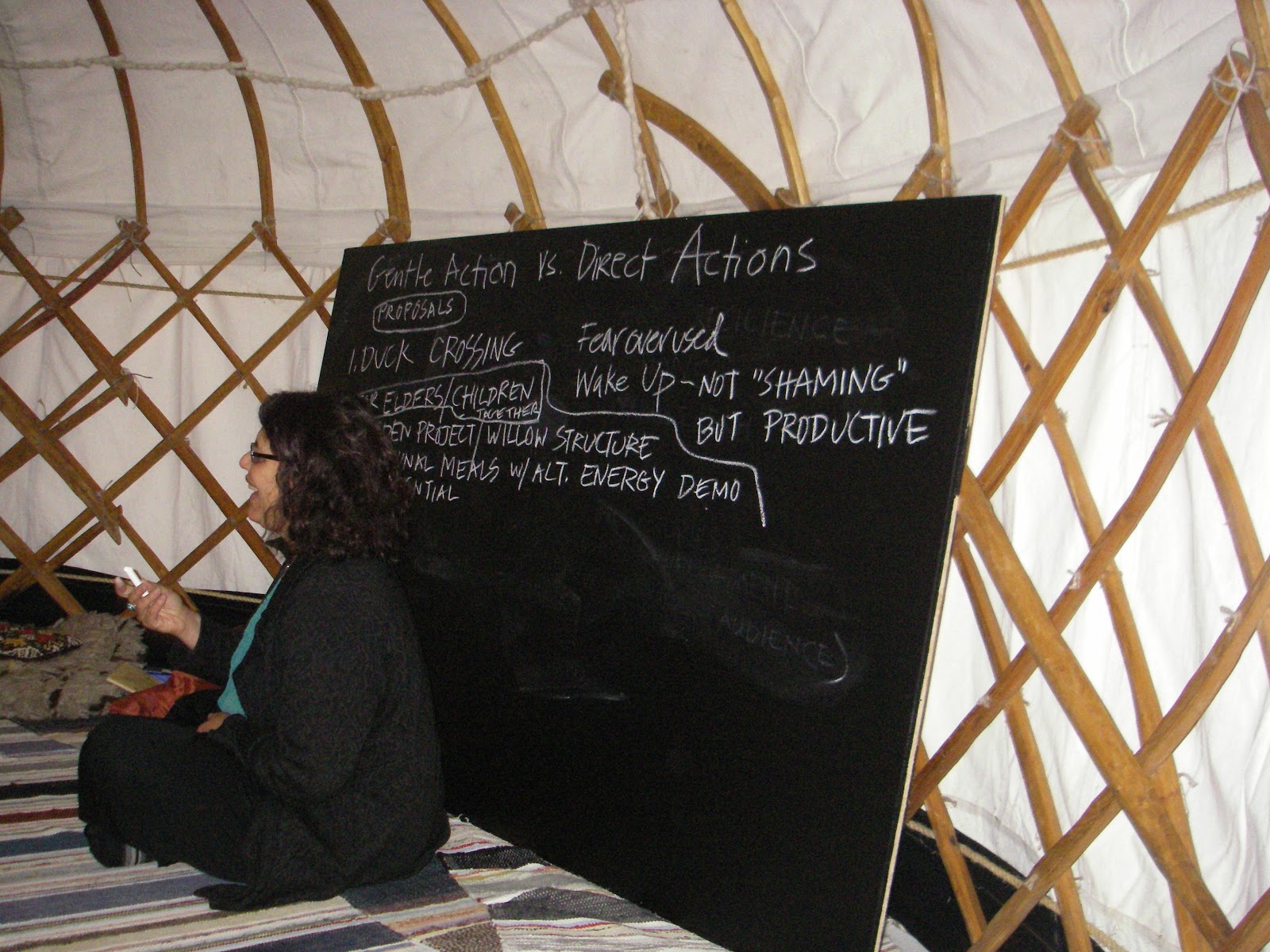
Gentle Action vs Direct Action - from workshop by Beverly Naidus |

23. lokakuuta 2010
The Habitat "Matter of Survival" is ready for inhabitants to move in


 |
| The frame of this very special yurt is made with students from the vocational college HAKTO 1995 by using only handtools, fire and steam. The mainly used wood is finnish slow and straight-grown pine slitted and dragged with traditional hand-technique (in Finnish: Jurtta on valmistettu perinteisillä puuntyöstökaluilla, lähinnä kirveellä ja puukolla, tulta ja höyrytystä hyväksi käyttäen. Pääosa puusta on mäntyä, joko kertahalkaistuna tai palhottuna vrt. päreen kiskonta) |

21. lokakuuta 2010
Gentle Action, Kunstnernes Hus, Oslo Norway
Building up the LEIRI - CAMP - YURT :
for GENTLE ACTION habitat "Interspecies collaboration"
for GENTLE ACTION habitat "Interspecies collaboration"

The word yurt is originally a Turkic word meaning the camp site and the imprint left in the ground by a moved yurt, and by extension, sometimes a person's homeland. The term came to be used in reference to the physical tent-like dwellings only in other languages. In modern Turkish the word "yurt" is used as the synonym of homeland. In Russian language the structure is called "yurta" (юрта), whence the word came into English.


 |
| Students from the vocational college HAKTO (Halikon käsi-ja taideteollisuusoppilaitos) has made this yurt 1995 by using only hand tools , fire and steam, with the master of yurt-making Hal Wynne-Jones (GB). |
2. lokakuuta 2010
Tarinankertojien leiri - Turun kirjamessut
-->
JURTTA
= villainen koti, jossa on sydäntuli.
”Jurtan olen pystyttänyt kunnianosoituksena vaeltajille ja tarinankertojille, joiden mukaan Maata ei voi omistaa, saatikka louhia”


”Mongolien talot ovat pyöreitä. Ne ovat rakennettu saloista, oksista ja huovasta. Näitä mongolit kantavat mukanaan minne tahansa kulkevatkin, sillä salot ovat tiukasti sidottu yhteen ja siten yhdistetty, että rakenteet ovat kevyitä kuljettaa.” kirjoitti Marco Polo 1200-luvulla.
Sana jurtta on alunperin turkkia ja tarkoittanut leiriä. Jurtta (ven. yurt, mong. ger) tarkoittaa nykyään asumusta, jota miljoonat paimentolaiset Siperiasta Keski-Aasiaan pitävät edelleen ympärivuotisena kotinaan toimivuutensa ja mukavuutensa tähden. ”Miksi katselisin samaa maisemaa oviaukosta päivästä toiseen – ei kiitos” sanoi eräs paimen vieraillessani Mongoliassa Mankhan Sumissa vuonna 1992. Jurtta on kaikkein laajimmalle levinnein paimentolaisasumus koko maailmassa.
Messuille ”tarinankertojien leiriksi” pystyttämäni jurtan olen valmistanut v. 1991 paimentolaisten tuorepuun käsittelymenetelmin ja sen rakenne on samanlainen kuin perinteisissä keski-aasialaisissa jurtissa. Nykyaikaisten jurttien katteena käytetään edelleen villahuopaa sekä päällisenä markiisikangasta. Tarina-jurtan ulkoasu ja sisustus väreineen ovat omaa käsialaani.
Taiteilijana jurtan rakentaminen on ollut minulle myös kulttuurien ja käsityötekniikoiden tutkimusta. Se on ollut myös jatke lapsuuteni sekä omien lasteni majanrakennusprojekteille, sekä matka perimmäisten tarinoiden äärelle. Jurtta on kuin villainen kohtu, jossa tyydyttyy kaipuu lämpimän sydäntulen ääreen, kaipuu köyhään, yksinkertaiseen luonnolliseen elämään.
Kotiväkeni kesken jurtta on mieluinen kesäolotila. Jurttani on kulkenut mukana monella työvaelluksella Suomessa, Ruotsissa ja Norjassa, festivaaleilla, juhlissa, käsityöleireillä ja osana taideteoksiani. Taiteilijat ovat nykyajan urbaaneja nomadeja, jotka paimentavat taidettaan laitumilta toiselle.
Jurtta on ympäristötaideteos. Siinä yhdistyvät arvot, käsityötaito, unelmat sekä toiveet luonnon ja kulttuurien monimuotoisuuden maailmasta. Jurtta on talo joka yhdistää luontoon – eikä eristä siitä. Kun sataa, ruoho sydäntulen ympärillä kastuu.
Tuula Nikulainen kirjamessuilla Turussa 30.9. 2010


JURTTA
= villainen koti, jossa on sydäntuli.
”Jurtan olen pystyttänyt kunnianosoituksena vaeltajille ja tarinankertojille, joiden mukaan Maata ei voi omistaa, saatikka louhia”

Kuva Nurduran Duman


”Mongolien talot ovat pyöreitä. Ne ovat rakennettu saloista, oksista ja huovasta. Näitä mongolit kantavat mukanaan minne tahansa kulkevatkin, sillä salot ovat tiukasti sidottu yhteen ja siten yhdistetty, että rakenteet ovat kevyitä kuljettaa.” kirjoitti Marco Polo 1200-luvulla.
Sana jurtta on alunperin turkkia ja tarkoittanut leiriä. Jurtta (ven. yurt, mong. ger) tarkoittaa nykyään asumusta, jota miljoonat paimentolaiset Siperiasta Keski-Aasiaan pitävät edelleen ympärivuotisena kotinaan toimivuutensa ja mukavuutensa tähden. ”Miksi katselisin samaa maisemaa oviaukosta päivästä toiseen – ei kiitos” sanoi eräs paimen vieraillessani Mongoliassa Mankhan Sumissa vuonna 1992. Jurtta on kaikkein laajimmalle levinnein paimentolaisasumus koko maailmassa.
Messuille ”tarinankertojien leiriksi” pystyttämäni jurtan olen valmistanut v. 1991 paimentolaisten tuorepuun käsittelymenetelmin ja sen rakenne on samanlainen kuin perinteisissä keski-aasialaisissa jurtissa. Nykyaikaisten jurttien katteena käytetään edelleen villahuopaa sekä päällisenä markiisikangasta. Tarina-jurtan ulkoasu ja sisustus väreineen ovat omaa käsialaani.
Taiteilijana jurtan rakentaminen on ollut minulle myös kulttuurien ja käsityötekniikoiden tutkimusta. Se on ollut myös jatke lapsuuteni sekä omien lasteni majanrakennusprojekteille, sekä matka perimmäisten tarinoiden äärelle. Jurtta on kuin villainen kohtu, jossa tyydyttyy kaipuu lämpimän sydäntulen ääreen, kaipuu köyhään, yksinkertaiseen luonnolliseen elämään.
Kotiväkeni kesken jurtta on mieluinen kesäolotila. Jurttani on kulkenut mukana monella työvaelluksella Suomessa, Ruotsissa ja Norjassa, festivaaleilla, juhlissa, käsityöleireillä ja osana taideteoksiani. Taiteilijat ovat nykyajan urbaaneja nomadeja, jotka paimentavat taidettaan laitumilta toiselle.
Jurtta on ympäristötaideteos. Siinä yhdistyvät arvot, käsityötaito, unelmat sekä toiveet luonnon ja kulttuurien monimuotoisuuden maailmasta. Jurtta on talo joka yhdistää luontoon – eikä eristä siitä. Kun sataa, ruoho sydäntulen ympärillä kastuu.
Tuula Nikulainen kirjamessuilla Turussa 30.9. 2010


Tilaa:
Blogitekstit (Atom)